

If you have watched big multinational brands, or even popular local businesses in your area, you will notice that some of them have experienced moments they did not plan for. These moments could include comment section trolling, negative reviews, a whistleblower calling out the brand over an issue, or even a simple misunderstanding caused by a marketing campaign.
When something like this happens, the first instinct of the team behind the scenes is usually to control the damage. And that makes sense. Companies and brands would always want to reassure their customers, and move past the situation as quickly as possible. But sometimes, an unexpected situation can become more than something a brand simply needs to recover from. The key is knowing how to turn a difficult situation into a positive opportunity without pretending that the situation itself is positive.
Let’s walk you through it in the next few paragraphs!
Not Every Problem Should Become a Marketing Campaign
This is an important distinction to make. Turning a situation into positive marketing does not mean making jokes about someone’s loss or using a serious incident for attention that benefits only your brand. It means asking, “What can our brand learn from this situation, and how can we respond meaningfully?”
For example, imagine a grill restaurant being gutted by fire. The immediate priorities should be safety, recovery, and supporting everyone affected. Marketing should not come before those things.
However, once the immediate situation is under control, the business could document its rebuilding journey, communicate openly with customers, show gratitude for their support, and eventually share a story about how it is rebuilding and moving forward.
The difference is that the business is not exploiting the incident. It is allowing people to follow a genuine story of resilience, responsibility, and recovery.
Case study: How KFC turned a chicken shortage into a memorable apology
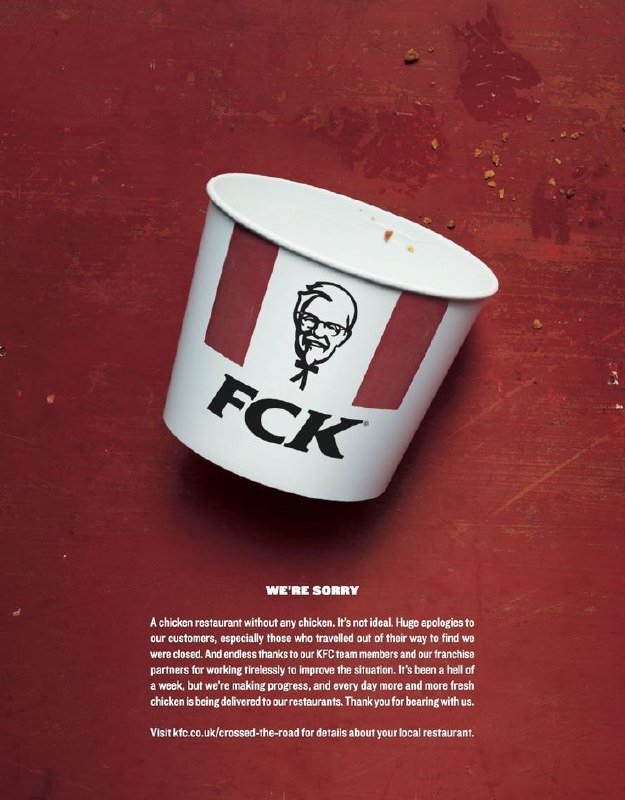
In February 2018, KFC experienced a major supply chain problem in the United Kingdom. The disruption left hundreds of its restaurants unable to operate normally because they had run out of chicken. For a restaurant chain known primarily for selling chicken, this was a particularly difficult situation to explain to customers.
Instead of issuing a formal statement, KFC and its creative agency, Mother London, came up with a bold response. They published an advertisement featuring an empty chicken bucket with the brand’s familiar letters rearranged to spell “FCK”. The advert openly acknowledged the problem and apologised to customers.
The campaign attracted widespread attention because it was honest, self-aware, and consistent with the brand’s cheeky personality. It did not pretend that running out of chicken was a good thing. Instead, it acknowledged the mistake in a way that felt human and memorable. The response was widely praised, and the campaign became a well-known example of crisis communication done creatively.
The lesson: Honesty, accountability, and a clear understanding of your brand’s personality can turn a difficult moment into an opportunity to rebuild trust. Humour can help, but only when it suits the situation and does not distract from taking responsibility.
Your Customers Are Already Talking. So Listen!
Social media has made this even more interesting because a brand could spend weeks in a boardroom planning a campaign, only for customers to create the conversation themselves, whether positive or negative.
A brand could be dragged on X or another social platform because customers are unhappy with its service, pricing, delivery process, or communication. The worst response may be to immediately become defensive without first understanding what people are saying. The truth is: criticism can contain useful information. If several customers are complaining about the same thing, there may be a genuine problem worth fixing. Once the brand addresses that problem, the improvement itself can become part of its brand story.
Imagine that a restaurant receives repeated complaints about slow delivery. Instead of ignoring the complaints or responding to every customer with the same generic apology, the business investigates the problem, identifies where delays occur, and improves its delivery process.
After making those changes, the restaurant can communicate what it has done and launch a campaign around its improved delivery experience.
In this case, the criticism became research. The research leads to improvement. And the improvement became marketing.
Of course, this only works if the business actually fixes the problem. Announcing a solution before doing the work can create even more distrust when customers discover that nothing has changed.
Show Customers What You Did With Their Feedback
One of the most powerful forms of marketing is showing people that a brand actually listens.
Customers do not necessarily expect businesses to get everything right all the time. However, they want to know that their experiences matter and that their feedback will not simply disappear into a suggestion box. Customer feedback can richly influence how the business operates.
This kind of content is particularly valuable because it offers proof rather than promises. Instead of saying, “We care about our customers,” the brand can show the specific changes it has made because of them.
And when customers see that a business is willing to improve, they have another reason to trust it.
What Happens When the Unexpected Attention Is Positive?
Not every unexpected situation involves criticism or bad publicity. Sometimes, a brand suddenly receives attention because something unusually good happens.
Perhaps a customer posts a video praising an employee, a product unexpectedly goes viral, or a funny moment involving the business gets shared thousands of times. Suddenly, people who had never heard of the brand are talking about it.
The question the strategy team then needs to ask is: What can we do with this attention?
Sometimes, the best response is simply to join the conversation, thank the people who shared the content, and let the moment breathe. Other times, the attention presents an opportunity to introduce people to something the brand has been building for a long time. The important thing is to respond intentionally rather than allowing the moment to pass without considering its potential.
When to Respond, When to Apologise, and When to Move On
Before turning an unexpected situation into content, a brand should consider a few questions:
- Who has been affected? If people have experienced harm or serious inconvenience, their needs should come before the brand’s desire for publicity.
- Is there a genuine issue to address? A clever response cannot replace fixing a real problem.
- Does humour suit the situation? What feels witty in one context may appear insensitive in another.
- What can we learn from this? An unexpected moment may reveal a weakness in the brand’s communication, customer service, or internal processes.
- What should happen next? The response should give customers a clear understanding of what the brand is doing, rather than simply trying to end the conversation.
These questions help a brand distinguish between an opportunity worth exploring and a situation that requires sensitivity, accountability, and little or no promotional activity.
In conclusion, when things go wrong, it is understandable for a brand to focus on damage control. But sometimes, the response to a difficult moment can tell customers more about a brand than a perfectly planned campaign ever could.
The same principle applies when the unexpected brings positive attention. A brand that understands its audience and knows what it stands for is better positioned to turn that attention into meaningful engagement and lasting relationships.
So, the next time something unexpected happens to your business, pause before reacting. Understand the situation, consider the people affected, and identify what needs to change.
Learn more business tips, and growth hacks at Brands & SMEs, our community for businesses and creators.